Storage is the cost that sneaks up on new owners. You budget for the boat and the motor, then discover that where the boat lives costs more per year than the servicing does. In Cape Town, with our weather and our security reality, storage is a real monthly line item, not an afterthought.
There are three broad options: a trailer at home, a commercial storage yard, or a marina berth. Each costs a different amount and each asks something different of you in return. Working out which one suits your boat and your budget before you buy saves a nasty surprise later.
The three options, and what they really cost
Cost goes well beyond the rent. Add the security, the weather exposure, the access you get and the wear the boat suffers while it sits. A cheap yard that leaves the boat in the open costs you in UV, rain and rust instead of rent.
| Option | Typical 2026 cost (Rand) | The trade-off |
|---|---|---|
| Trailer at home (own property) | R0 direct cost | Space, access, security risk, weather exposure |
| Secure storage yard (open) | R600 – R1,500 / month | Cheaper, boat exposed to sun and rain |
| Secure storage yard (under cover) | R1,200 – R2,800 / month | Better protection, higher cost |
| Marina berth (small boat) | R2,000 – R4,000 / month | Instant access, more fouling and maintenance |
| Marina berth (larger hull) | R4,000 – R9,000+ / month | Convenience at the top of the cost range |
| Trailer storage elsewhere (lock-up) | R500 – R1,500 / month | Keeps driveway clear, needs towing to launch |
Add a one-off or annual angle too. A trailer parked on the street or in a communal area needs a lock, and possibly a wheel clamp. A boat kept on the water needs anti-fouling, which is a real cost every season, and growth on the hull eats performance and fuel.
Keeping it at home
Home storage is free in cash and expensive in other ways. If you have the space, a trailer in the driveway is the cheapest option on paper. Launch is easy, access is instant, and you know exactly where the boat is.
The catch is Cape Town. A boat parked outside sits in the sun and the winter rain, and both do damage. UV attacks covers, electronics and tubes on an inflatable. Rain finds every seal and every hatch. Salt air reaches anything within a few kilometres of the coast.
There’s a security angle too. Boats and outboards are stolen, and a hull on a trailer in a visible driveway is an easy target. A lockable coupling, a wheel clamp and good insurance aren’t optional if the boat lives outside.
And there’s the space question. A boat with a trailer is roughly the footprint of a car and a half. A larger cabin boat with a braked trailer needs a turning circle to match, which not every driveway has. If you park it on the street, you’re relying on the neighbourhood and the law.
Commercial storage yards
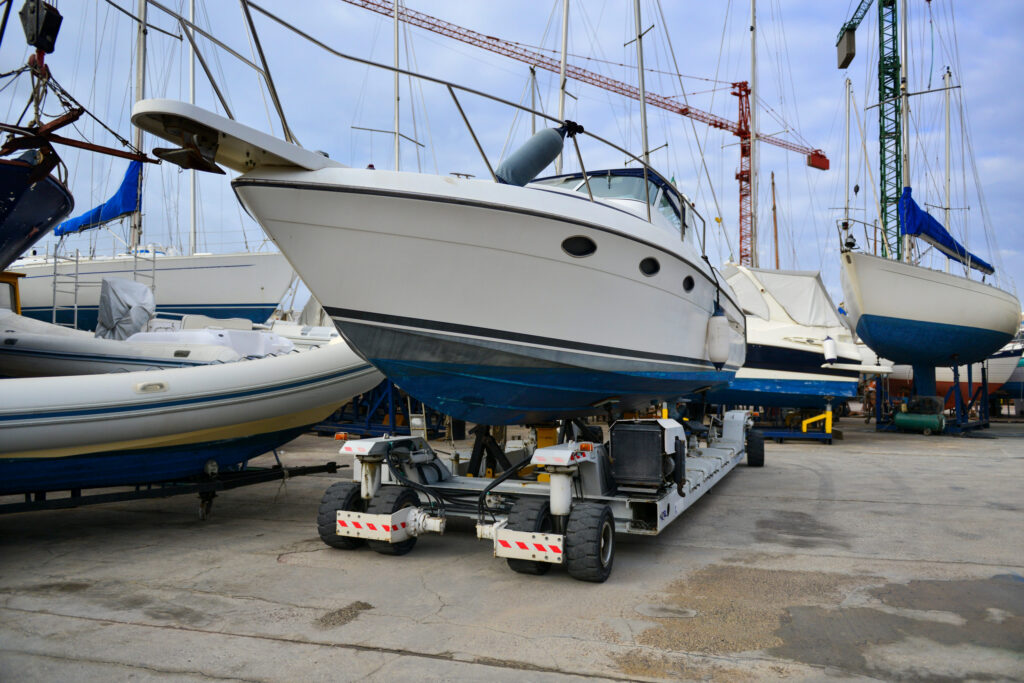
A storage yard gives you security and someone watching the boat. Most charge monthly, offer a range from open stands to under-cover bays, and give you access by arrangement. For a boat that lives outside the home anyway, a yard is the sensible middle ground.
Look at what the yard actually provides. Open ground is cheap and leaves the boat as exposed as your driveway. A covered stand or a shed is worth the premium, because it keeps the sun and the worst of the rain off. Ask about security, access hours, and whether you can work on the boat at the yard.
Ask about power too. A boat with a battery that needs trickle charging, or one that needs a wash after every trip, does better at a yard with water and power. Load-shedding already punishes batteries left sitting, and a stored boat that isn’t charged is a launch-day breakdown waiting to happen.
Marina berths
A berth is the most convenient option and the most expensive. The boat stays on the water, ready to go, and you walk on with your gear. For anyone who fishes often, that convenience has real value.
It also comes with maintenance. A boat kept in the water needs anti-fouling, and it grows weed and barnacles on anything that sits below the waterline. Anodes wear faster. Hull cleaning becomes routine. That’s the flip side of leaving a boat floating.
Berths in Cape Town are in demand and priced accordingly, and a larger hull climbs quickly. If you’re comparing a berth against a yard, add the anti-fouling and hull-cleaning costs to the berth before you decide.
Storage and the condition of your boat
Where a boat lives shapes what it costs to keep. A boat stored dry on a trailer, washed and covered, ages far slower than one left wet on a mooring. That shows up at resale.
If the boat sits for months, the motor suffers too. Fuel goes stale, batteries drain, and a four-stroke that isn’t run develops its own problems. A stored boat needs to be started and run regularly, and it needs servicing on schedule even in a season it barely went out.
That’s where our outboard servicing team comes in. We can keep a stored boat’s motor healthy, and our mobile workshop can come to the boat if the trailer isn’t road-ready or you’d rather not move it.
What storage adds to the cost of owning
Say you buy a mid-size cabin boat on finance. Add insurance, the annual Certificate of Fitness, servicing, fuel and storage, and the monthly figure climbs fast. Storage alone can swing the whole calculation, because it’s the one cost that never stops, whether or not the boat goes out.
A trailer at home keeps the number down and makes the boat affordable. A marina berth makes it convenient and turns it into a serious monthly commitment. Most Cape Town owners land somewhere in between, with a trailer and a storage yard or a yard that keeps the driveway clear.
If you’re still working out the purchase, our guide to boat finance in South Africa covers what the bank wants to see and what deposit you’ll need. Storage is the cost that finance doesn’t show you.
When you’re ready to buy, browse our new and used boat sales and boat and outboard stock, or ask us about trading in your current rig through boat trade-ins. Then contact our team at Atlantic Suzuki and we’ll help you match the boat to the space you actually have.
Frequently asked questions
How much does boat storage cost in Cape Town?
An open storage yard runs roughly R600 to R1,500 a month, under-cover storage R1,200 to R2,800, and marina berths R2,000 to R9,000 or more depending on the size of the boat. Storing at home on a trailer costs nothing directly but exposes the boat to weather and security risk.
Is it better to store a boat on a trailer or in the water?
A trailer keeps the boat out of the water, so no growth and no anti-fouling, and it’s cheaper to store. A marina berth is more convenient and ready to use, but it means anti-fouling, hull cleaning and faster anode wear. It depends on how often you go out.
How much does a marina berth cost?
In Cape Town, a berth for a smaller boat might run R2,000 to R4,000 a month, and a larger hull can climb past R9,000. Berths are in demand, so expect to wait for one and to pay for the convenience.
Does storage affect boat insurance?
Yes. Where the boat is stored affects the premium and sometimes the cover conditions. A locked yard or a berth in a monitored marina is usually viewed more favourably than a boat parked on a public road.
Should I cover my boat if it’s stored outside?
A good cover protects against UV and rain, but it must let the boat breathe, because trapping moisture causes mould and corrosion. A cover that fits badly does more harm than good, especially in coastal salt air.
What’s the cheapest way to store a boat?
On its own trailer at home, provided you have the space and can secure it. Beyond that, an open storage yard is the cheapest paid option, with covered storage a middle step and a marina berth the most expensive.
About the Author
Written by the team at Atlantic Suzuki. We’ve spent years in the Cape Town marine trade, selling, servicing and fitting boats and outboards from Montague Gardens. As an authorised Suzuki dealer, we help Western Cape owners keep their boats running and their motors healthy, wherever the boat is kept.