

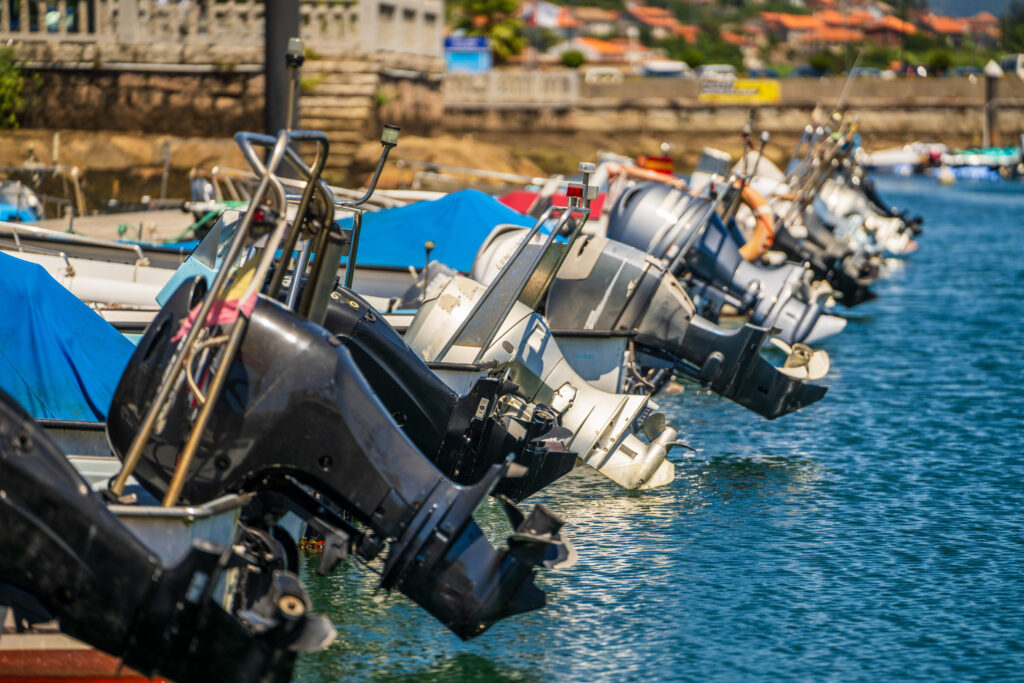
You’ve found the boat. Now comes the question that trips up more buyers than any other: what size outboard motor does it actually need? Get it wrong and you either end up with a boat that can’t get on plane (too small) or a motor that weighs the transom down and burns fuel (too big).
The good news is there’s a rule of thumb that works for 90% of boats. And Atlantic Suzuki carries the full Suzuki outboard range from 2.5hp to 350hp, plus Mercury, Honda, and Yamaha options, so we can match any hull to the right power.
The Rule of Thumb: 75-100% of the Hull’s Maximum Rating
Every boat has a maximum horsepower rating stamped on the capacity plate (usually near the helm or on the transom). Never exceed this number it’s a safety limit. But you don’t need to max it out either. The sweet spot is 75-100% of the maximum rating.
- For a hull rated at 100hp max: run a 75hp to 100hp motor
- For a hull rated at 200hp max: run a 150hp to 200hp motor
- For a hull rated at 300hp max: run a 225hp to 300hp motor
Going below 75% means the boat will struggle to plane, handle poorly at low speeds, and burn more fuel trying to compensate. Going above the max is dangerous and voids your insurance.
Outboard Size by Boat Type
| Boat Type | Length | Recommended HP | Suzuki Model |
|---|---|---|---|
| Dinghy / Tender | 2.5-3.5m | 2.5 – 15hp | DF2.5S, DF6A, DF15A |
| Small runabout | 4-5m | 30 – 60hp | DF30A, DF40A, DF50A, DF60A |
| Fishing / Ski boat | 5-6.5m | 70 – 140hp | DF80A, DF100B, DF115B, DF140B |
| Offshore / Cabin | 6.5-8m | 150 – 250hp | DF150A, DF200A, DF250T |
| Large offshore | 8m+ | 250 – 350hp | DF250AP, DF300AP, DF325A, DF350A |
Browse the full Suzuki 4-stroke outboard range by horsepower to see specific models and specifications.
How Weight Affects Your Choice
A 140hp outboard from one brand might weigh 170kg, while a 140hp from another brand weighs 190kg. That 20kg difference changes how the boat sits on the water and how it handles. Suzuki’s DF range is consistently the lightest in each horsepower class. The DF100B weighs 169kg, while equivalent Honda and Yamaha models are 10-15kg heavier. On a 6m fishing boat, that weight saving translates to better fuel economy and a higher payload capacity.
Single vs Twin Engines
Most recreational boats run a single engine. Twin engines are for:
- Offshore boats over 8m where redundancy matters
- High-performance boats that need the extra power
- Commercial fishing vessels that run long distances
- Charter boats where breakdown could mean lost income
If you’re not in one of these categories, a single engine is cheaper to buy, cheaper to maintain, and more fuel-efficient. Twins double your maintenance costs and fuel consumption for marginal safety gains on coastal cruising.
2-Stroke vs 4-Stroke: Still a Question in 2026?
4-stroke outboards dominate the market now. They’re cleaner, quieter, and more fuel-efficient. The main advantage of a 2-stroke outboard is lower upfront cost and lighter weight for the same horsepower. If you’re on a tight budget or need a lightweight motor for a small inflatable, a 2-stroke makes sense. For everything else, go 4-stroke.
Read our full 4-stroke vs 2-stroke comparison for the detailed breakdown.
What About Fitment?
If you’re replacing an old outboard or fitting a new one to an existing boat, professional fitment matters. The motor needs to match the transom height (shaft length), the control cables need to be compatible, and the wiring needs to be done properly. We handle fitment of all outboard brands at our Montague Gardens workshop.
FAQ — Outboard Motor Sizing
Q: Can I put a bigger motor on my boat than it was designed for?
No. The maximum horsepower rating on the capacity plate is a legal and safety limit. Exceeding it invalidates insurance and can cause structural failure at speed.
Q: Will a smaller motor save fuel?
Not necessarily. An underpowered boat struggles to plane and uses more fuel trying. The right-sized motor running at cruising speed is the most efficient setup.
Q: How do I know my transom height?
Measure from the top of the transom to the bottom of the hull. 381mm is a short shaft (small boats), 508mm is a long shaft (most fishing boats), 635mm is an extra-long shaft (large offshore boats).
Q: Do you offer demo rides to test different motors?
Yes. Contact us to arrange a sea trial with the boat and motor combination you’re considering.
Not sure what size you need? Call Atlantic Suzuki on 021 555 1977 or visit us in Montague Gardens. Tell us your boat type and we’ll recommend the right horsepower.